Tesamorelin and CJC-1295 with DAC; a head to head comparison
Condensed summary:
Tesamorelin
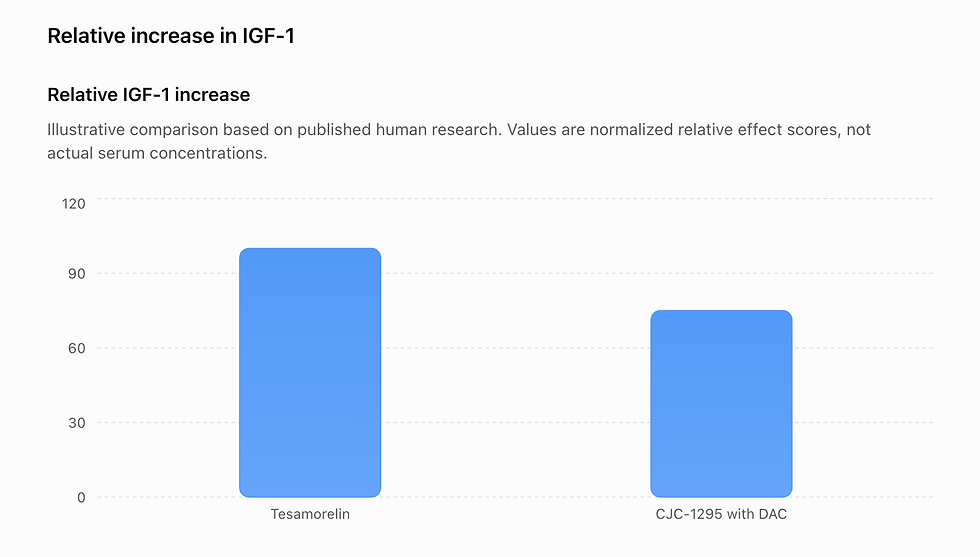
Typically increases IGF-1 by approximately 100–180% above baseline in responsive individuals.
Produces physiological GH pulses, but because it has a relatively short half-life, GH elevation is not sustained throughout the day.
CJC-1295 with DAC
Produces more prolonged GH secretion for several days after dosing because the DAC component binds to albumin, extending its half-life to around one week.
IGF-1 generally increases substantially, but average increases tend to be somewhat smaller than those achieved with Tesamorelin in studies using therapeutic doses.

Overall:
For maximizing IGF-1: Tesamorelin generally has the stronger evidence.
For sustained GH exposure with less frequent injections: CJC-1295 with DAC is generally the stronger option.
Keep in mind that responses vary considerably with dose, age, body fat, endogenous GH reserve, and whether a GH secretagogue such as a ghrelin receptor agonist is used concurrently.
Digging deeper, both of these compounds belong to a class known as secretagogues. A secretagogue is any compound that stimulates the body to release one of its own hormones rather than supplying the hormone directly. In this case, both Tesamorelin and CJC-1295 with DAC stimulate the pituitary gland to release endogenous growth hormone.
The distinction is that there are two major classes of GH secretagogues:
GHRH analogs (GHRH receptor agonists)
Tesamorelin
CJC-1295 with DAC
Sermorelin
Modified GRF (1-29)
Ghrelin receptor agonists (growth hormone secretagogues in the narrower sense)
Ipamorelin
MK-677 (Ibutamoren)
GHRP-2
GHRP-6
Hexarelin
These activate the ghrelin receptor (GHS-R1a), which also stimulates GH release via a complementary pathway.
Because these pathways are complementary, combining a GHRH analog (such as Tesamorelin or CJC-1295 with DAC) with a ghrelin receptor agonist (such as Ipamorelin) can produce a greater GH response than either agent alone, although the response remains constrained by the body's normal feedback mechanisms, including rising Insulin-like growth factor 1 levels and somatostatin. This is one reason these agents tend to produce more physiological patterns of GH secretion than administering exogenous growth hormone itself.
Sources:
Teichman, Sam L., et al. "Prolonged Stimulation of Growth Hormone (GH) and Insulin-Like Growth Factor I Secretion by CJC-1295, a Long-Acting Analog of GH-Releasing Hormone, in Healthy Adults." The Journal of Clinical Endocrinology & Metabolism, vol. 91, no. 3, 2006, pp. 799–805. https://doi.org/10.1210/jc.2005-1536.
Ionescu, Mariana, and Lawrence A. Frohman. "Pulsatile Secretion of Growth Hormone (GH) Persists during Continuous Stimulation by CJC-1295, a Long-Acting GH-Releasing Hormone Analog." The Journal of Clinical Endocrinology & Metabolism, vol. 91, no. 12, 2006, pp. 4792–4797.
Sackmann-Sala, Luciana, et al. "Serum Proteome Profiling after Administration of CJC-1295, a Long-Acting Growth Hormone-Releasing Hormone Analog, in Healthy Adults." Growth Hormone & IGF Research, vol. 19, no. 5, 2009, pp. 471–479.
Stanley K. Grinspoon, et al. "Effects of Tesamorelin, a Growth Hormone-Releasing Factor, in HIV-Infected Patients with Abdominal Fat Accumulation: A Randomized Placebo-Controlled Trial." The Lancet, vol. 373, no. 9670, 2009, pp. 117–125.
Falutz, Julio, et al. "Effects of Tesamorelin, a Growth Hormone-Releasing Factor, in HIV-Infected Patients with Abdominal Fat Accumulation: 52-Week Extension Study." AIDS, vol. 24, no. 5, 2010, pp. 661–670.
Stanley, Tara L., et al. "Effects of Tesamorelin on Visceral Fat and Liver Fat in HIV-Infected Patients with Nonalcoholic Fatty Liver Disease." The Lancet HIV, vol. 6, no. 12, 2019, pp. e821–e830.
Clemmons, David R., et al. "Safety and Metabolic Effects of Tesamorelin, a Growth Hormone-Releasing Factor Analogue, in Patients with Type 2 Diabetes: A Randomized, Placebo-Controlled Trial." PLOS ONE, vol. 12, no. 6, 2017, e0179538. https://doi.org/10.1371/journal.pone.0179538.


Comments